Offroad Recovery Gear Questions

I used aluminum, I used synthetic line, I used all the lightest stuff money can buy. I even purchased a winch based on reputation and its weight. I had synthetic line way before it became popular. Still came out around 400 lbs of stuff. Had it been iron or steel, closer to 500 or more. There is no right or wrong, just understand to whom you are addressing. 25 plus years experience has taught me to run as light as is possible.
That's crazy, I'm not sure how you managed to get to 400lbs from rope and aluminum pulleys. My entire recovery kit including straps, 4 pulleys, soft shackles, and a 30 ft freedom rope weighs in at 52.8 lbs... It all fits between 2 bags that are strapped to my roll bars in the jeep.

I don't carry a hi-lift but I know those aren't 350 lbs. I have a bottle jack that can lift the axle for tire changes.
 
  • Like
Reactions: Viking1204
That's crazy, I'm not sure how you managed to get to 400lbs from rope and aluminum pulleys. My entire recovery kit including straps, 4 pulleys, soft shackles, and a 30 ft freedom rope weighs in at 52.8 lbs... It all fits between 2 bags that are strapped to my roll bars in the jeep.

I don't carry a hi-lift but I know those aren't 350 lbs. I have a bottle jack that can lift the axle for tire changes.
First off- with the 80 series I used to run, the front bumper alone weighed 150 lbs. another 50 lbs for the second AGM battery. Winch 75lbs, etc etc etc.

A comparable bumper on our current truck would way close to 225 lbs. add a winch and plate- 100lbs +/- add 2nd AGM battery- 45lbs. add 4 iron d rings, 15-20lbs , Hi lift 25-30lbs, hi lift accessories, 15-20 lbs. straps and tree saver maybe 12 lbs. it adds up fast- very fast. You not only have the extraction gear, you have to have all the other stuff that will support the extraction gear. Upon reflection it adds up to less than 500lbs, somewhere around 400- for the F-350. The 80 series had about 325 +/- extra lbs.
 
  • Like
Reactions: Viking1204
First off- with the 80 series I used to run, the front bumper alone weighed 150 lbs. another 50 lbs for the second AGM battery. Winch 75lbs, etc etc etc.

A comparable bumper on our current truck would way close to 225 lbs. add a winch and plate- 100lbs +/- add 2nd AGM battery- 45lbs. add 4 iron d rings, 15-20lbs , Hi lift 25-30lbs, hi lift accessories, 15-20 lbs. straps and tree saver maybe 12 lbs. it adds up fast- very fast. You not only have the extraction gear, you have to have all the other stuff that will support the extraction gear. Upon reflection it adds up to less than 500lbs, somewhere around 400- for the F-350. The 80 series had about 325 +/- extra lbs.
So you no longer have a bumper or a winch? I guess that's a decision you made to limit yourself on places that you can camp. I wouldn't consider bumpers part of the recovery equipment since that's trail armor, IMO. It's non-negotiable for where I go.

Here I am, questioning whether I should change up to a Gladiator and a Four Wheel Camper because it might be too big to get to some of my favorite fishing and camp spots. Sounds like you're driving a barge. :sweatsmile:
 
Any added weight in either recovery or protection is a concern. I would like to have rock sliders on my 109 but the added weight takes away from the amount of gear(and quality of camp life) I can take, based on my GVW. Then it restricts where I can go, such as Dusy Ershim, Rubicon, Moab, Sand Hollow, if I don't want to take on body damage.
For sure, some one driving an Earth Roamer isn't doing the same back roads in Nevada as I. It's part of the bargain we make when we decide on a vehicle. You do you, let others be themselves.
 
  • Like
Reactions: Viking1204 and MOAK
So you no longer have a bumper or a winch? I guess that's a decision you made to limit yourself on places that you can camp. I wouldn't consider bumpers part of the recovery equipment since that's trail armor, IMO. It's non-negotiable for where I go.

Here I am, questioning whether I should change up to a Gladiator and a Four Wheel Camper because it might be too big to get to some of my favorite fishing and camp spots. Sounds like you're driving a barge. :sweatsmile:
True- after having had 2 vehicles over the course of 22 years, an outfitted ‘04 Rubicon then an 80 series that were capable of traversing 99.9% of all legal roads in North America, we now have a very capable truck that’ll get us through 99% of all legal roads. Interestinginhly- the Landcruiser fully loaded with all our gear scaled out at 7,000 lbs dragging a 1,500 lb trailer. The F-350 flatbed with Grandby and fully loaded with all our gear scales out at 10500 lbs., just under GVWR, no winch, no heavy aftermart bumper. Every pound counts. I’ve priced the aluminum bumpers- yikes.
 
  • Like
Reactions: Viking1204
Every pound counts. I’ve priced the aluminum bumpers- yikes.
Aluminum in a real rough environment becomes a wear item also.. It will with stand some hits but they dent and get damaged with repeated abuse.

My next vehicle I'll probably do it anyways, just to be weight conscious in some areas. For me at least, the bumpers and winch are non-negotiable. We live an hour from the Rubicon trail and often find ourselves doing steep angled drops and climbs, and getting over boulders to get into some of our favorite camping and fishing spots. Some of our forest roads and off-shoots get pretty rough, even when you're not on a named 4x4 trail.
 
Last edited:
  • Like
Reactions: Viking1204
These weight calcs are interesting. My 2020 Colorado is now less than 500lb below GVW (2 people, small dog, 50L water and full fuel)
Considering bumpers, slider, skid plates, extra battery/electrical, tools, and recovery gear accessories are probably +60% of my weight above base.
I don't think I made any considerations for weight in this area.

I dont know if its right, but I mostly went cheap &heavy on the recovery/tools except a few soft shackles.
to be clear, cheap because heavy...and i know a guy
the only thing i regret the weight of is snatch blocks and tree straps. at about 20lbx4 and 4x10lb big a$$ straps... they weigh on my soul.
but lift rated and i think i got the lot for about $50 Canadian and im willing to bet i saved 3x that weight on stuff that i did spend stupid $$ on.
i will be swapping stuff as the budget allows

i think as long as the stuff is quality, adequately rated, serve a purpose, and falls within the overall system; weight can be distributed between recovery/ protection/ living/ luxury
 
  • Like
Reactions: Viking1204
the only thing i regret the weight of is snatch blocks and tree straps. at about 20lbx4 and 4x10lb big a$$ straps...
If you're using synthetic winch line, those heavy snatch blocks are made for steel cable and not ideal for synthetic line.

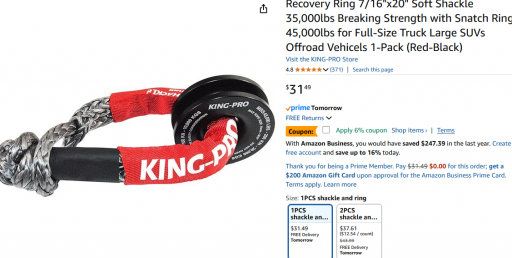
These are just a few bucks more than a snatch block and weigh a lot less.
1753283597878.png
 
  • Like
Reactions: Viking1204
Hey guys, I've grown up living in the woods, getting firewood deep in the woods, taking trucks, or whatever offroad, so I'm not entirely new to all of this, but I'm kind of new to it as an official hoby...

I'm starting to do more offroading/overlanding just for fun, and I want make sure I'm setup to get myself unstuck, and help others safely.

At this point, my offroad rig, is just my daily driver 94 Ram 2500 on Falken 265 70 17s. I know it's not great, but it's surprisingly capable. It weighs in around 5,200lbs.

I have a 20' tow strap, but that's it.

For starters, I'd like to get a 30' kinetic rope, a couple of soft shackles, and a receiver hitch tow point/hitch link.

I'm on a pretty tight budget, so for the kinetic rope and soft shackles, I'll be going no name Chinese Amazon special... do I go 7/8" or 1" though? Part of me says to go 7/8 since the whole principle of kinetic energy is being stretchy, and 7/8 is typically recommended for vehicles up to 6k lbs. The other part of me says to go with 1" since it's typically recommended for ¾ ton and up trucks, and it's Chinese, so overkill is better. What do I go with?

Now, for the receiver hitch... a buddy of mine has the Factor 55 hitchlink 2.0 that I've used when I got stock in about 2 feet of snow and he had to yank my out. I really liked it, and I know they are rated for kinetic type pulls. I can get one on ebay for around $60. I can get a Kurt shackle mount for $40 on Amazon that is rated for 13k lbs for a straight pull. Here's my question... my truck with some extra gear could easily hit 6k lbs. If I was stuck in the mud bad, and you mix that with some kinetic force, you could easily be looking at over 20k lbs of force as I understand it. Maybe I'm wrong on that? Is the cheaper Kurt option a good way to save money, or is the Factor 55 the way to go. I know I don't want to skimp houston Commercial electrician on metal parts, since it's be better to have the soft (i.e. rope, or soft shackle) parts of the equation break first...

Hope this all makes sense!
Thanks in advance!
Please help a newbie out!!
Off-road recovery gear is essential for safely handling situations where a vehicle becomes stuck in mud, sand, snow, or rough terrain. Common recovery tools include tow straps, recovery ropes, shackles, traction boards, and a reliable jack, each designed to assist without causing damage to the vehicle or risking personal safety.
 
  • Like
Reactions: Viking1204
So you no longer have a bumper or a winch? I guess that's a decision you made to limit yourself on places that you can camp. I wouldn't consider bumpers part of the recovery equipment since that's trail armor, IMO. It's non-negotiable for where I go.

Here I am, questioning whether I should change up to a Gladiator and a Four Wheel Camper because it might be too big to get to some of my favorite fishing and camp spots. Sounds like you're driving a barge. :sweatsmile:
After a friend reminded me of how my wife and I like to travel, ( way off grid ) and what it would cost to have an extraction of our truck, and after a ton of research I installed the Ford/Warn 12,000 lb winch, keeping the stock Ford bumper. I also switched all the old steel & iron shackles to soft shackles, saving about 25 lbs. The winch & supporting structural steel weigh about 130 lbs. now I have to figure out where to carry the chainsaw. We’re just about out of room.
 
So you no longer have a bumper or a winch? I guess that's a decision you made to limit yourself on places that you can camp. I wouldn't consider bumpers part of the recovery equipment since that's trail armor, IMO. It's non-negotiable for where I go.

Here I am, questioning whether I should change up to a Gladiator and a Four Wheel Camper because it might be too big to get to some of my favorite fishing and camp spots. Sounds like you're driving a barge. :sweatsmile:


Well, there's plenty of barge size overlanding to do. Ill save the tight trails for another year.

I also stopped the winch bumper bit. Truck claws, 35' of chain, and a chain come along or high lift jack.

Winches need frequent maintenance tear downs over here. So consider that.

On my F250, I'd love a Warn bumper and winch. Not happening any time soon. And still, the weight penalty bugs me. It could be the difference between upgrading to a camper, or another TT (Ibex?).
 
After a friend reminded me of how my wife and I like to travel, ( way off grid ) and what it would cost to have an extraction of our truck, and after a ton of research I installed the Ford/Warn 12,000 lb winch, keeping the stock Ford bumper. I also switched all the old steel & iron shackles to soft shackles, saving about 25 lbs. The winch & supporting structural steel weigh about 130 lbs. now I have to figure out where to carry the chainsaw. We’re just about out of room.
IMO that's a great call. Making the investment to get rid of all the steel components is a happy medium that saves weight without sacrificing capabilities.

I think 12k lbs probably won't get you out of a frame deep hole with your rig, and I'm sure you're aware of that also, so knowing when to pull the cable before you get there is going to be important.

Well, there's plenty of barge size overlanding to do. Ill save the tight trails for another year.

I also stopped the winch bumper bit. Truck claws, 35' of chain, and a chain come along or high lift jack.

Winches need frequent maintenance tear downs over here. So consider that.

On my F250, I'd love a Warn bumper and winch. Not happening any time soon. And still, the weight penalty bugs me. It could be the difference between upgrading to a camper, or another TT (Ibex?).
I LOL'd at that first sentence. It's true though, there's plenty of places that you can take a barge.

I keep my winch covered when not in use. There's a lot of water and UV resistant winch covers on Amazon and (knock on wood) I've been lucky so far.
 
  • Like
Reactions: Viking1204
To winch or not to winch, that is the question.

I hope I do not regret this sentiment or jinx myself into some biblical desert humiliation, but I just lost three hundred pounds in a single afternoon by ripping the winch and old front bumper off my truck. Gone. Evaporated. The new bumper weighs one hundred and fifty pounds, which means I still came out ahead and that alone feels like a small miracle in a world where nothing ever gets lighter unless it is your wallet.

For a long time I defended that monstrous slab of steel like it was a loyal dog. Ugly as hell, yes, but useful, I told myself. The winch justified the whole crime against aesthetics. That bumper looked like it was designed by a committee of angry refrigerators, but I clung to the idea that one day it would save me in a heroic moment involving danger, grit, and applause.

That day never came.

After more than a year of internal debate, barroom arguments, and actual time spent outside in the real dirt, I had to admit the truth. I almost never used the winch for myself. I used it to rescue other people, and in nearly every case those people had made catastrophically bad decisions. Decisions so bad that even while helping them I felt a strange moral resistance, like maybe the universe was trying to teach them something and I was interfering.

People are generally good, especially in the off road crowd. But when they are not good, they are really not good. There is no middle ground. It is either camaraderie and cold beers or a lawsuit waiting to hatch.

There is also the small matter of geography. I live in the desert now. Vast, empty, beautiful stretches of nothing. No trees. No posts. No convenient anchors. I am not wrapping a winch line around a cactus unless I want to be remembered as an idiot. And as for Moab, I would not even know where to begin. Winching there feels like a philosophical exercise more than a practical one.

Yes, another vehicle is the best winch point. Yes, traveling with a group is the smartest move regardless of what gear you own, but someone else will inevitably have a winch and probably better judgment. When I look honestly at how I use my truck and where I actually go, there is no practical reason to keep hauling around that steel monument to hypothetical heroism.

So I let it go.

Now the truck looks leaner, meaner, and finally honest. More Clint Eastwood, less Bubba Gump. And if fate decides to punish me for this decision later, at least I will face it without three hundred extra pounds of ugly steel weighing down my conscience.
 
I am out alone many times and once you need a winch, you will have a winch for life LOL. I can get out of almost anything, that makes me feel good.

Well worth it IMO

Jim

BUT does matter what overlanding you do, is it forest roads or rocks and boulders? Big difference.